
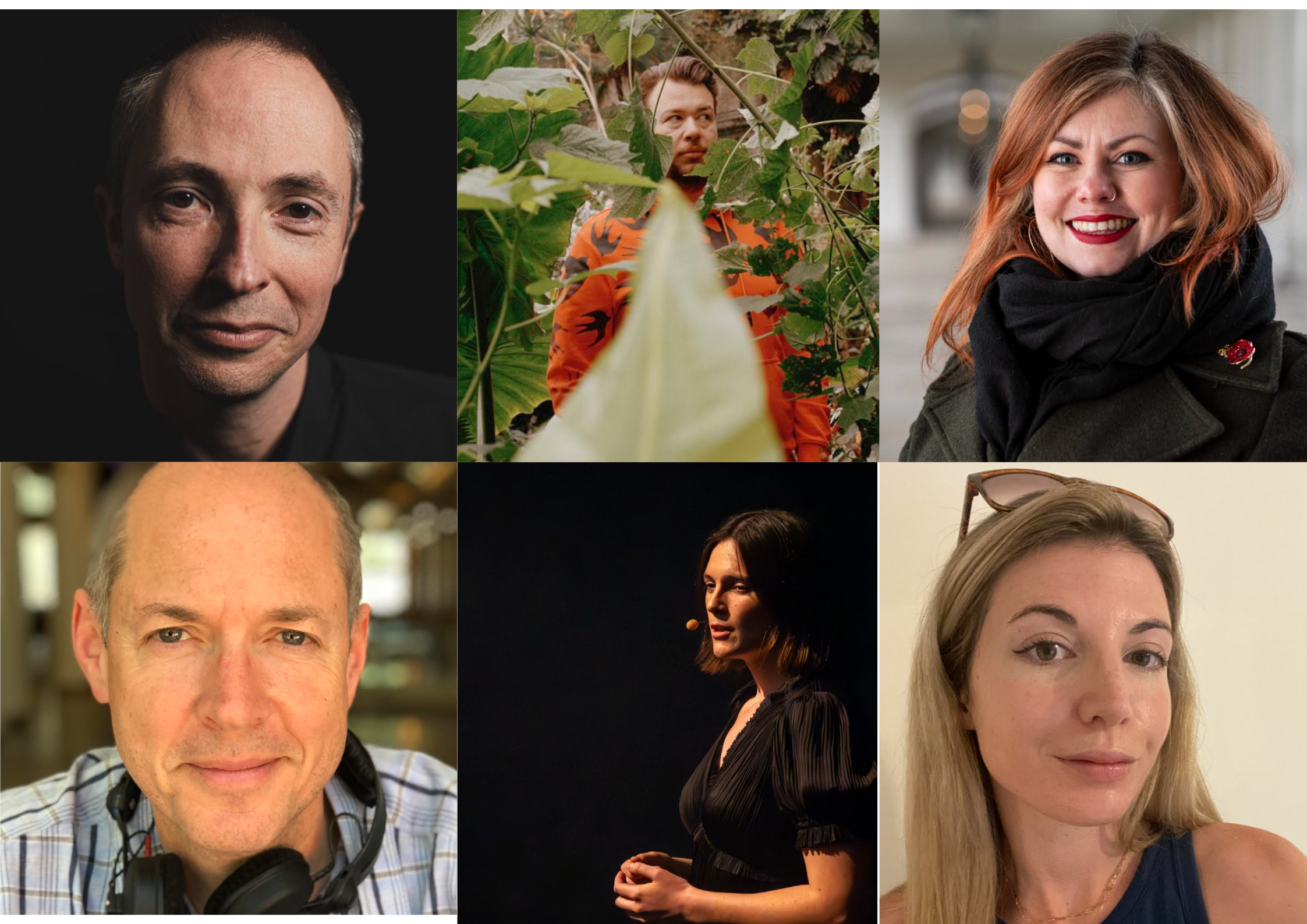
We’re refreshing our board and welcoming six new trustees, the result of an extensive open recruitment process. Between them they have skills in governance, fundraising, artistic planning, the recording industry and experience as artists, conductors and composers.
They are composer and conductor Aaron Holloway-Nahum, composer, producer and academic. Toby Young, fundraising professional Marianne Wright, composer, percussionist and educator Dominic Murcott, product leader and soprano Julia Sinclair and creative music industry professional Nikki Camilleri.
We’re also appointing musician and lawyer Tariq Bhatty as our first ever trainee trustee.
Aaron Holloway-Nahum
Aaron Holloway-Nahum is a composer, conductor, recording engineer and sound artist working at the intersection of contemporary concert music and multi media. As a conductor and arts entrepreneur, he most prominently serves as the conductor, Chief Executive, and co-Artistic Director of Riot Ensemble, an organization that gives more than thirty performances per year and has premiered over 350 original works. Alongside his experience as a recording engineer and managing director of Coviello Productions (clients incl. the Arditti Quartet, Sandbox Percussion, Ensemble Intercontemporain, etc.) Aaron recently took on a new role as the Head of Soundscape with Southby Productions, through whom he has supported artists ranging from Holly Herndon to Chase & Status. Aaron is on the composition faculty of the Royal Academy of Music.
Q&A
What is your favourite nonclassical release?
Jasmine Morris’ Astrophilia – Jasmine is such a wonderful and exciting voice emerging in the British music scene (though we’ve – hopefully only temporarily – lost her to America while she does her doctorate). We had just commissioned Jasmine when this album came out, and I remember absolutely rinsing it for a couple of weeks and getting hugely excited about what she was going to make.
Where do you most often listen to music?
The immersive audio studio I run in Hackney as part of my role with Southby.
What is your first/best formative musical memory?
Funnily enough, it is playing the violin… which I only did for a year or two before promptly quitting and taking up singing!

Toby Young
Toby Young is Professor of Composition at the Guildhall School of Music & Drama, where his work spans composing, producing, and developing innovative approaches to music-making. His music has been commissioned and performed worldwide. Alongside this work, he has built a substantial cross-genre profile, collaborating with artists including Chase & Status and the Rolling Stones. As a producer, Toby has worked with major opera companies and orchestras. He was previously Head of Music for Punchdrunk. Toby’s research and creative practice focus on how technology can reshape composition and performance. He also leads socially engaged projects with young offenders, refugees, and massed community choirs.

Q&A
What is your favourite nonclassical release?
The Art of Remix EP 1. I absolutely love remixes, or anything that reimagines something and takes it in new directions. Also, who doesn’t love a mixtape?
Where do you most often listen to music?
I always listen to music on headphones while heading around the city, curating my own soundtrack to, for example, tube journeys.
What is your first/best formative musical memory?
My parents are both orchestral musicians, so I was very lucky that my early experiences included being snuck into various rehearsals of top London orchestras.
Marianne Wright
Marianne Wright is senior fundraiser at Royal Museums Greenwich. Her interest in charity governance grew through working with Arch Sinfonia, and she has held roles with the European Union Youth Orchestra and Street Orchestra Live. Earning a first-class honours degree in classical vocal performance at Trinity Laban Marianne recalls a formative experience performing at an early Nonclassical club night which solidified the transformative power of experimental music-making for her. She has since been a committed advocate for artists pushing boundaries and challenging perceptions, passions she is excited to bring to Nonclassical alongside her wealth of professional expertise.
Q&A
What is your favourite nonclassical release?
I really love vari/ations – it really is an Ode to Oram. The music is so varied, and I love how real archival recordings of her voice are blended quite compellingly with the music to really keep her spirit alive – not just as a nod to her advocacy for women’s relevance in a male-dominated industry, but you can also hear how the composers have picked up on her influences, like spiritualism and otherworldliness, which adds depth and another layer of interpretation.
Where do you most often listen to music?
When I’m working on important funding deadlines, I’ll often listen to instrumental music, as it really helps keep me in the zone (I get too distracted by wanting to sing along otherwise!). But I do love to put a record on when cleaning my flat on a Saturday morning or have music to sing to in the car going just about anywhere!
What is your first/best formative musical memory?
Probably the first time I sang Britten’s St Nicolas and his Ceremony of Carols in concert when I was about 10 with the Cantamus Girls Choir. Ceremony of Carols has been one of my favourite things to sing my whole life, and I suppose was the foundation of my love for more modern classical music.

Dominic Murcott
Dominic Murcott is a composer, percussionist, curator and educator based in London, and whose music has been released on Nonclassical. Beginning as a self-taught musician he played drums and percussion with many influential bands, notably as the vibraphonist with art-pop outfit The High Llamas and drummer with Ted Milton’s no-wave trio Blurt. Recording has been with Stereolab, Pavement, Cathal Coughlan and St Etienne to name a few. He received a PhD in Acoustic and Electronic Composition from Goldsmiths College before being made Head of Composition at Trinity Laban Conservatoire of Music and Dance. Now in his 23rd year in the post, the department is oversubscribed and renowned for its innovative approach to composition training and focus on community. An avid forager and cook, he presented a special event on taste in food and music at the British Library with legendary chef Heston Blumenthal in 2019.
Q&A
What is your favourite nonclassical release?
Not a fair question – too many choices! I could be cheeky and name my own work or things I’ve been involved with, but I’ll suggest something else. It could be Simon Knighton’s Sound Sculpture No. 4 Pt. 3, which is pure genius. Alex Paxton is a genius too, but I think I’m going to choose two other ones: the first is a newish release by Tara Cunningham called Almost – Not Exactly. It’s minimal, highly detailed and each track is less than 90 seconds long! My second choice is Live @ nonclassical vol. #1. I have very fond memories of the early days of the organisation, and this record is packed with people who have become friends.
Where do you most often listen to music?
It depends on the listening ‘mode’. I assess about 200 new works a year as part of my job as an educator, from teenagers learning their chops to massive PhD portfolios. This needs time, focus and good monitoring, so it’s in my studio at home or my office at Trinity Laban, with its view over the Thames. Apart from that, I love listening while on the move: I’m currently training for a half-marathon, so there is plenty of time while running. I used to listen while cycling, but I don’t feel safe doing that any more, particularly as I’m in a virtual world thanks to noise-cancelling headphones. Any public transport is a good place; my favourite is the window seat on a long train journey with something to look forward to at the other end.
What is your first/best formative musical memory?
This has to be Sun Ra in a tiny hall in a village in Austria in 1990. I was on tour with a band from Berlin, and we were on our way to a festival in Slovenia when it was still part of Yugoslavia. My bandmates had told me a little about what to expect, but the experience was simply out of this world. The Arkestra arrived on a tour bus after the audience was already gathered, put lots of gear on stage, then disappeared, re-emerging shortly after wearing their trademark robes and hats. They burst into a free-music frenzy for about 10 minutes, saxophonist Marshall Allen’s veins about to explode from his forehead, then morphed into percussion-only samba for another 10 before taking the volume down to a whisper and everyone chanting, “Sun Ra, from outer space, will entertain you now”. Sun Ra himself appeared, elderly but resplendent with a large purple beard, led on stage by singer June Tyson. He sat at the keyboard and led the band through a set of Fletcher Henderson charts, playing the intros while everyone searched through their music for the right tune. They left the stage, then returned for a complete set of Disney tunes, bringing two trombonists forward to feature in Pink Elephants on Parade from Dumbo. I stood at the front the whole time with a pint of beer in a plastic glass. At the end it was warm and I hadn’t drunk a single mouthful.

Julia Sinclair
Julia Sinclair is an experienced Product Leader, with extensive Fintech, data and asset management experience across B2B and B2C solutions. In her current role as Head of Product at CapitalRise, she oversees Technology and Product strategy for a luxury property investing business. She is also a director of the UKCFA (UK Crowdfunding Association). She studied Engineering at the University of Cambridge, where she also held a choral scholarship. She now balances a performing career as a soprano with her above work, performing regularly as a soloist and with many professional London choirs. Her debut album Wind takes flight, a modern tribute to Hildegard of Bingen, was released in July 2025 on Nimbus Records, following successful launch concerts in the Concertgebouw, Amsterdam and Grand Junction, London.
Q&A
What is your favourite nonclassical release?
My favourite nonclassical release is Para a frente by Késia Decoté. I was lucky enough to hear her perform live at IKLECTIK with an old housemate of mine, Omar Peracha, whose piece Colour Etude II appears on that EP.
Where do you most often listen to music?
I listen to music whenever I travel – I’m in my own world, stomping down the road with my noise-cancelling headphones on. My recent favourites include Rosalía’s Lux and Olivia Chaney’s The Longest River.
What is your first/best formative musical memory?
This is hard! The moment I decided I needed to be involved in music was probably singing Nicholas Maw’s One Foot in Eden, Still I Stand on a choral course at 15. It was the first time I had heard such rich choral music, let alone performed it, and I definitely caught the bug!

Nikki Camilleri
Nikki Camilleri is a creative music industry professional with an entrepreneurial spirit and passion for bringing creative ideas to life. Innovation and sustainability in the creative industries are topics of interest for her and motivate her work. She specialises in scouting successful IP, digital music distribution, project development and artist/industry relations. Her work has seen her sign independent acts such as Ayelle, Alfa Mist, Cat Burns (Top 10 charting), and James Vickery, giving many of them their first deal, sign exclusive release deals with Scouting For Girls and work releases by household names such as David Guetta, Disciples and many more. She is a Fellow of the Royal Society of Arts, a UN Women Delegate 2024, directly supports and mentors independent artists as well as having served as a visiting lecturer at London College of Music (UWL), City University and London College of Contemporary Music (LCCM). In 2024 she was selected for the Forbes 30 under 30 in the music and entertainment category for her work. This year she has served as a judge for the PRS Women Make Music Grant, Youth Music Awards and MOBO Awards.
Q&A
What is your favourite nonclassical release?
I’m still new to familiarising myself with the whole back catalogue (there are over 70 records!) and looking forward to discovering my favourite.
Where do you most often listen to music?
I’d say, hands down, live! I also love the raw sound of vinyl, but the immersive feel of hearing an act live – nothing beats it for me!
What is your first/best formative musical memory?
One of my most formative memories was at Glastonbury in 2017, where I worked in stage management and sat on a hill overlooking the entire site and realised just how massive the festival was and how many people love music. It reminded me of the community it creates and the importance of

Tariq Bhatty
(trainee trustee)
Tariq Bhatty is a lawyer at Warner Music, working in international legal and business affairs to support some of the world’s most popular current and legacy artists. Alongside his legal career, Tariq is a trained music student and active performing musician, with a longstanding involvement in live music and collaborative projects.
Drawing on his experience as both a musician and music-industry lawyer, he is particularly interested in how organisations can create accessible pathways for musicians working outside traditional spaces.
Q&A
What is your favourite nonclassical release?
HachiRen by Chihiro Ono.
Where do you most often listen to music?
The question is, where do I not listen to music?
What is your first/best formative musical memory?
Watching (repeatedly) Simply Red and Michael Jackson on VHS as a kid at my nan’s house.
